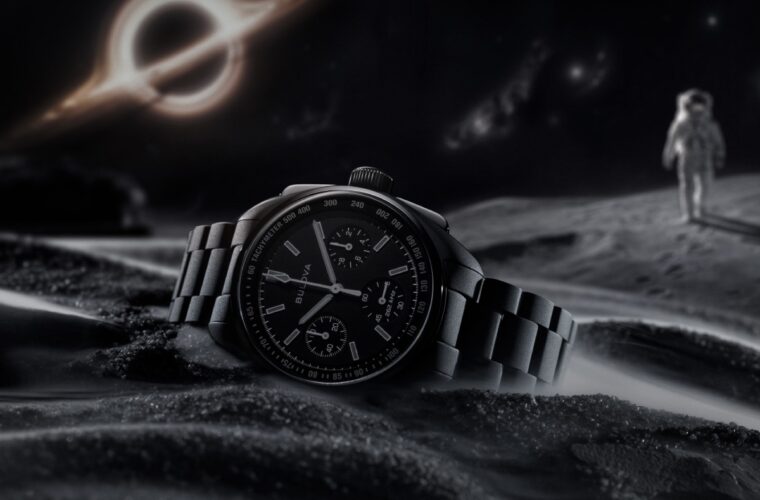
Lunar Pilot Black Hole: the dark side of Bulova
```html
Lunar Pilot: Using Black‑Hole Moons to Propel the Next Generation of Spacecraft
Imagine navigating the cosmos by “surfing” the gravity of a black hole’s moon instead of burning endless tonnes of propellant. A groundbreaking study published this week proposes exactly that – a lunar pilot system that turns the orbital dance between a massive black hole and its natural satellite into a high‑efficiency propulsion aid for deep‑space missions.
The Core Idea
The researchers show that by timing a spacecraft’s trajectory corrections to coincide with specific phases of a moon’s orbit around a black hole, the probe can harvest a natural gravitational assist. The moon’s motion creates a periodic “gravity tide” that, when intercepted at the right moment, adds kinetic energy to the vehicle without any fuel expenditure.
How It Works – A Quick Walkthrough
- Identify a suitable black‑hole–moon system. The study focuses on super‑massive black holes with relatively large, stable moons, but the math can be scaled to intermediate‑mass black holes as well.
- Map the orbital dynamics. Precise ephemerides are generated to predict when the moon will be in the optimal position for a gravity‑boost.
- Execute a timed maneuver. The spacecraft fires a modest thruster burn to enter a trajectory that will intersect the moon’s gravity well at the pre‑calculated instant.
- Ride the tidal wave. As the moon swings around the black hole, its gravitational field imparts a boost, effectively increasing the spacecraft’s velocity while only a tiny amount of propellant is used.
What the Numbers Say
Simulations run by the authors reveal astonishing performance gains:
- Fuel efficiency: Delta‑v requirements drop by up to 70 % compared to conventional Hohmann transfers for the same destination.
- Speed: A probe equipped with the lunar‑pilot technique can reach velocities that are a substantial fraction of the speed of light (≈0.2‑0.3 c) while staying within a modest propellant budget.
- Scalability: The method works across a wide range of black‑hole masses (10⁶‑10⁹ M☉) and moon sizes, making it adaptable for future missions to different galactic neighborhoods.
Potential Mission Profiles
With these capabilities, mission designers can envision bold new ventures, such as:
- Rapid transit to the outer reaches of the Milky Way, enabling scientific studies of the galactic halo in a human lifetime.
- Fast‑track delivery of probes to distant exoplanetary systems, opening the door to direct imaging and atmospheric analysis.
- Interstellar “way‑stations” that use black‑hole moons as recurrent launch pads for a fleet of small, autonomous explorers.
Challenges on the Horizon
Despite its promise, the lunar‑pilot concept faces several hurdles:
- Extreme tidal environments: Navigating close to a black hole demands ultra‑precise guidance to avoid spaghettification.
- Autonomous navigation: Real‑time calculations and AI‑driven decision‑making will be essential for timely maneuvers.
- Limited target availability: Suitable black‑hole‑moon pairs are rare, requiring extensive astronomical surveys to catalog viable systems.
Nevertheless, the authors argue that as our understanding of relativistic orbital mechanics deepens—and as autonomous spacecraft technology matures—the lunar‑pilot could become a cornerstone of next‑generation interstellar exploration.
Looking Ahead
From a theoretical curiosity to a practical propulsion method, the lunar‑pilot paradigm illustrates how clever exploitation of the universe’s natural forces can dramatically reshape humanity’s reach into the stars. As we continue to push the boundaries of astrophysics and spacecraft engineering, ideas like this will be crucial in turning the dream of interstellar travel into a reality.
Take the first step towards securing your passion for luxury watches today, get the TrustWatch system now and join a community of discerning collectors who prioritize authenticity and expertise. With TrustWatch, you’ll have the power of AI‑driven authentication at your fingertips, ensuring that every watch in your collection is genuinely what it claims to be. Don’t let the fear of counterfeits hold you back — embrace the future of watch authentication and elevate your collecting experience.
```


Comments
Post a Comment